
Thomas County Deed Types
The Thomas County Register of Deeds takes in each original signed and notarized instrument. Each one gets a book, page, and recording time. The grantor gives up an interest. The grantee receives it. Type matters here, because only deeds convey interests, while mortgages, releases, liens, easements, and plats each document a different strand of the property records.
| Deed Type | What It Does | Common Use |
|---|---|---|
| Warranty deed | Conveys the land with promises stated in the instrument | Ordinary sale or transfer |
| Quitclaim deed | Conveys only the interest the grantor may hold | Family or corrective transfer |
| Correction deed | Repairs an error in an earlier filing | Name or description correction |
| Executor or administrator deed | Transfers land under estate authority | Probate sale or distribution |
| Mortgage release | Clears or changes a recorded loan interest | Encumbrance research |
A deed is proof of a recorded transfer. A mortgage or lien works differently. It is an encumbrance, a claim that can burden the land without moving ownership. Always search releases and satisfactions on their own, since a lien you can see may already have a later clearing document filed under a different date or book reference in the deed records.
Thomas Deeds Begin in 1885
The county's own recordkeeping history lays out a clear timeline. Handwritten land books start in 1885. In-house microfilm began in 1972. Database entry started in 2004, with manual indexing still running alongside it. E-recording arrived in 2014. The county still reports that records are not available online. E-recording is only a filing route, not a public deed viewer. The county publishes no remote deed index, public search form, or image subscription. Ask which medium covers the year you need. One chain can cross physical books, microfilm, the office database, and scanned documents. It can do so without ever changing custodians. The official recordkeeping page carries the full chronology.
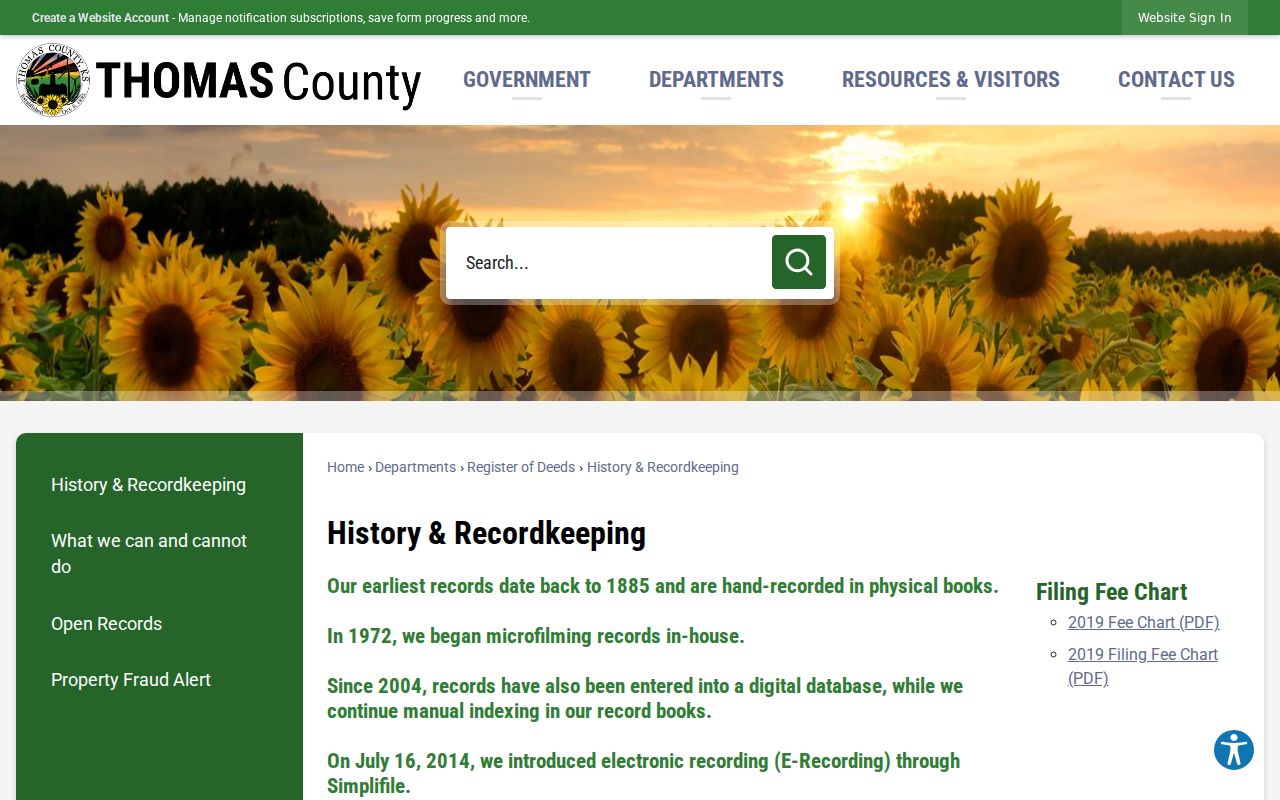
Its timeline explains why the earliest local deed year is not an online cutoff.
Use the Previous Deed Description
Thomas County tells filers to pull the complete legal description from the previous deed. Don't rely on the Appraiser website. Platted land normally runs by lot, block, and subdivision or addition. Unplatted land usually runs by section, township, and range. A short description may strand a document in the miscellaneous book. Bring the tax description as a locating clue. Compare it word for word with the prior instrument. Add initials, married names, punctuation variants, and entity suffixes. Also add an approximate year and any book-page reference you hold. Correction deeds, affidavits, probate orders, and replats can bridge gaps in the property records. Some gaps only look like breaks.
Local rule. The property card helps locate land, but the prior recorded deed supplies the filing description.
Walk Thomas Grantor-Grantee Books
Start with the current CAMA owner and legal description. Request the newest deed under that name and tract. Read its prior grantor, recording date, description, and book-page reference. Then search that grantor as a grantee in the period before. Repeat the cycle down to the 1885 books. A break in the chain may call for probate, partition, correction, or court records before the deed trail continues.
- Use the county tax search to save the current name and tract keys.
- Request the latest deed, then copy its parties, description, date, and reference.
- Search the prior grantor as an earlier grantee, allowing spelling variants.
- Bridge breaks with probate, court, plat, atlas, or correction records.
- Grantor
- The party transferring the stated interest.
- Grantee
- The party receiving the stated interest.
- Chain of title
- The ordered sequence of recorded transfers for one tract.
- Book and page
- The recorder's reference used to retrieve an instrument.
Request a Thomas County Deed
The Register of Deeds sits at 300 N Court Avenue, Colby, KS 67701, and answers at 785-460-4535. Hours run weekdays, 8:00 a.m. to 5:00 p.m. Give staff the document type, every known party, an approximate year, book and page if known, and the prior deed's legal description. Ask whether a plain or certified copy fits your need, and request a cost estimate up front. K.S.A. 28-115 sets the recording and certification charges. The first page of a deed, mortgage, or instrument costs $17. Each added page costs $13. Those filing charges do not fix the price of ordinary inspection or every copy type. Confirm the current office charge before you pay, since fee schedules can shift; the official Register of Deeds page posts current details.
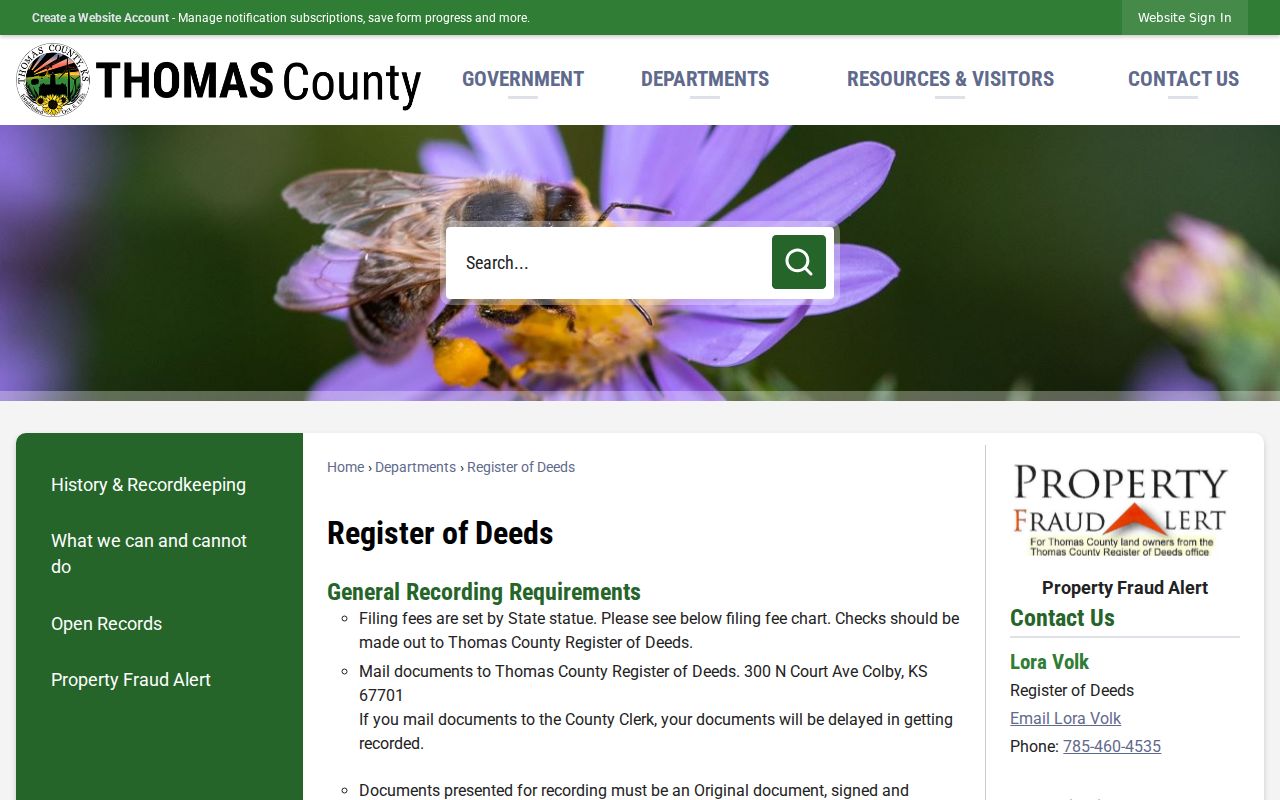
It is the primary access point because no county public deed viewer was found.
Recorded, not guaranteed. The index shows filed instruments. It does not insure title, reveal every unrecorded interest, or locate boundaries.
Open and Restricted Thomas Records
Nearly all recorder records stay open during business hours under the Kansas Open Records Act. The county flags two restricted categories. Real Estate Sales Validation Questionnaires and military discharges are closed. A restricted sales questionnaire is not the public recorded deed. So the deed itself remains open. A narrow written request needs no set KORA form. State the parties, date range, instrument, description, and reference. The custodian may ask for locating details, charge actual reasonable costs, and, where available, send records electronically. If access is denied, ask for the explanation in writing.
Atlases as Thomas Chain Clues
The 1907 and 1928 Thomas County plat atlases are held at the Kansas State Archives. They name landowners at fixed points in time. Prairie Museum also holds 1887 Colby map material. These help when a farm had no stable address or an addition changed names. An atlas label still does not prove a transfer. Kansas tract books document initial federal conveyances by section, township, and range. They are not owner-name indexes. Use the tract-book guide plus the legal description to reach the first transfer. Then return to the Thomas County deed books for later ownership. Newspaper legal notices can supply names and dates. Probate files can too when the recorded chain breaks.
Note: Treat historic maps as leads only; the exact chain must rest on recorded instruments and court authority.
Thomas Deed Recording Details
Thomas County expects a filing to arrive as an original, signed, and notarized instrument. Printed names belong beneath the signatures. The notary stamp must be clear, the text legible, and the legal description complete. Acceptance then sets the Register's workflow in motion: the office records the time, assigns book and page, indexes and scans the document, and enters it in the land-index book before returning the original.
K.S.A. 58-2221 adds a tax-side handoff. The recorder sends the grantee's full name and last known post-office address to the County Clerk for tax statements. That step explains why a deed can shift the mailing trail before an annual appraisal cycle catches the transfer, though it does not promise a same-day owner update.
Ordinary copies stay capped at 11 by 17 inches. Larger survey or easement sheets are usually declined. Only a new subdivision plat breaks that rule. Before presenting a filing, confirm sizes, fees, and year-end cutoff hours with the office. Those acceptance rules sit apart from ordering a public copy.
Build a Complete Thomas Deed Request
A strong request names its exact target. Give the most recent owner or grantee, each known prior grantor, the approximate recording year, instrument type, any book and page, and the full legal description. Attach the tax result only as a locator. When the ordinary grantor-grantee chain stops, ask staff to check correction deeds, affidavits, miscellaneous-book entries, releases, and replats. Keep each record class separate. A warranty or quitclaim deed documents a conveyance. A mortgage creates a recorded security interest, an assignment shifts who holds it, and a release or satisfaction can clear it. An easement can burden or benefit the land without conveying the whole parcel. A plat maps an addition or subdivision. A probate order or quiet-title judgment explains authority, yet a later recorded deed may still be needed to finish the land trail.
Estate work starts in the probate case: search the District Court file for letters, a sale order, final settlement, or heirship material. Then compare names, legal description, and representative capacity against the recorder's instrument. Save the court case number and parties. Request the mortgage, assignment, lis pendens, sheriff's deed, judgment, and releases one by one. Court and deed records answer linked but distinct questions.
Era-based requests speed historical digging. For 1885 through 1971, ask for handwritten deed books, grantor-grantee indexes, and plats. For 1972 through 2003, ask whether in-house microfilm or the manual index works better. For 2004 forward, ask about the office database and scans. Do not call them remotely public. E-recording from 2014 forward shows submission, not public searching.
The Prairie Museum rounds out the paper trail. Its holdings include newspaper legal notices, obituaries, census material, photographs, yearbooks, and map clues. The stated research service carries a $15 per-hour minimum, with paper copies at $0.15 and microfilm reader-printer copies at $0.25. Such clues fix spellings, estates, farm names, or dates. They never replace the recorded deed. Label every archival clue by source and date.
Monitor Thomas Deed Activity
Thomas County links an enrollment service called Property Fraud Alert. Once enrolled, a user gets notified when a matching name shows up. That match appears in newly recorded material. It is a monitoring aid. An alert is not proof of fraud and no substitute for reading the instrument itself.
Confirm first. Check the party spelling and recording date. Also confirm the document type, book-page reference, and legal description with the Register of Deeds. Names can match by coincidence. Skip any unsolicited company selling a decorative copy until you have checked the county's own copy route and fee. Report a suspected false filing through official channels after obtaining the recorded instrument.