
Thomas County Tax Record Fields
The county's Thomas County tax-information module reaches both current statements and older ones. The form splits searches into Real Estate, Personal Property, Oil, Gas, Trucks, Minerals, and State Assessed Utilities. A lookup can run on year, tax ID, CAMA number, or owner of record. It can also run on address, subdivision, or rural legal description. Those fields make it easier to pin down the exact parcel account. That account sits within Thomas County property records.
| Field | What It Shows | Where |
|---|---|---|
| Appraised value | Fair-market estimate as of January 1 | Appraiser |
| Assessed value | Taxable share after the class rate | Appraiser |
| Tax year and type | Period and class covered | Tax module |
| Bill status | Current, paid, due, or delinquent data if returned | Treasurer |
| Taxing units | County, city, school, and other levy context | Clerk/Treasurer |
Kansas sets the assessment rate by classification. Residential property is assessed at 11.5 percent. Vacant lots are assessed at 12 percent. Agricultural use value is assessed at 30 percent, and commercial or industrial real property at 25 percent. That classification has to be confirmed for each parcel before the numbers mean anything. Assessed value is not the sale price. The tax bill, likewise, is not a deed and proves nothing about title.
Thomas Tax Types and Years
Oil, Gas, Minerals, and Utility options matter here in a High Plains county. One rural address can tie into several separate tax sets. A street address may not capture the whole record trail. The Lease Name field helps then. Use starting and ending years to keep results tied to the intended cycle. Checkboxes narrow the view to current taxes or statements with taxes due, including delinquent items. Before moving on to another office, save the tax unit, parcel ID, and CAMA number. The county's tax-search help appears below.
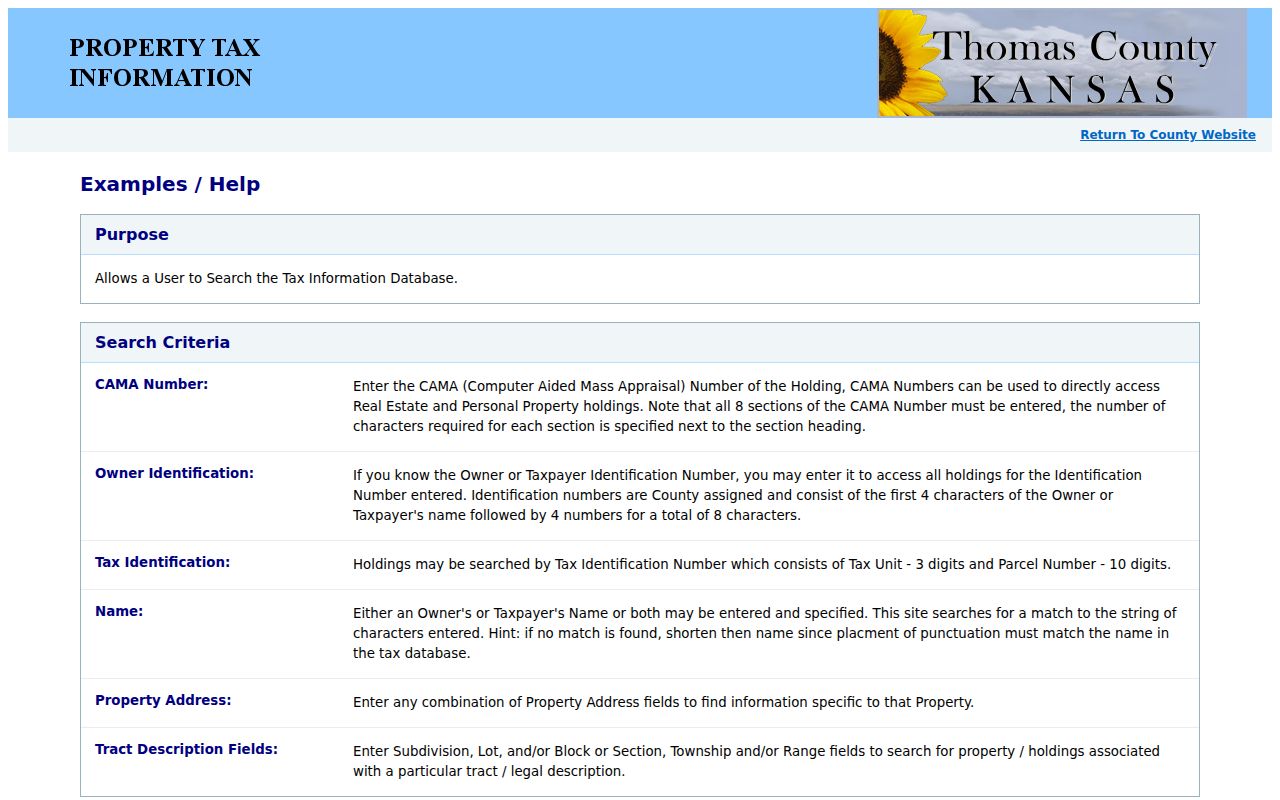
Its guidance favors narrow identifiers and shorter owner names when punctuation blocks a match.
Thomas County Tax Calendar
The calendar starts on January 1, the valuation date. March 1 brings the real-property value notice. Appraisal and Clerk certifications land in June and July. The tax roll is certified in November as statements go out. December 20 is the due date for the full amount or first half. Delinquent real estate runs on its own schedule. Publication happens in August. The county can purchase the parcel on the first Tuesday of September. Any portal flag should be read with its year and stage. It may indicate unpaid tax, publication, or county purchase rather than a completed title transfer.
Look Up a Thomas Tax Bill
Start with the fewest reliable fields. An address works well for a known site, while a CAMA or tax ID number pins down the exact parcel. For owner searches, a last name alone is safest, since punctuation in the record must match your entry; if results look off, try Current Owner, Taxpayer, and Both to catch differences between mailing names.
- Search by address, CAMA, tax ID, or legal description.
- Select the tax type and year range.
- Compare bill status with the Appraiser record.
- Ask the Treasurer to confirm any delinquency or sale stage.
- Assessed value
- The taxable share after a class rate.
- Mill levy
- The rate applied by local taxing bodies.
- Tax statement
- The bill for a stated year and account.
- Tax lien
- A recorded claim linked to unpaid tax.
Challenge a Thomas County Value
A value notice opens the appeal path. Contact the County Appraiser promptly after the March notice arrives. Review the classification, land facts, listed improvements, and comparable sales before you argue your case. Kansas also offers payment-under-protest procedures. The Board of Tax Appeals form plus its current instructions govern that route. The 2025 Thomas County market study reported a 2 percent residential trend. It showed no commercial trend and an 8 percent vacant-lot trend. Those countywide figures are not guaranteed changes for your parcel. Evidence tied to the specific parcel carries more weight in an appeal.
Act on the notice. Appeal rights have short statutory windows. Confirm the filing date with the Appraiser or Board of Tax Appeals.
Thomas County Tax Offices
The Appraiser sets classification and value. The Clerk certifies values and levies, while the Treasurer bills, collects, and tracks payment status. The Register of Deeds records conveyances and liens. Each office answers a different corner of a Thomas County property tax records question. The Thomas County Appraiser page appears below.
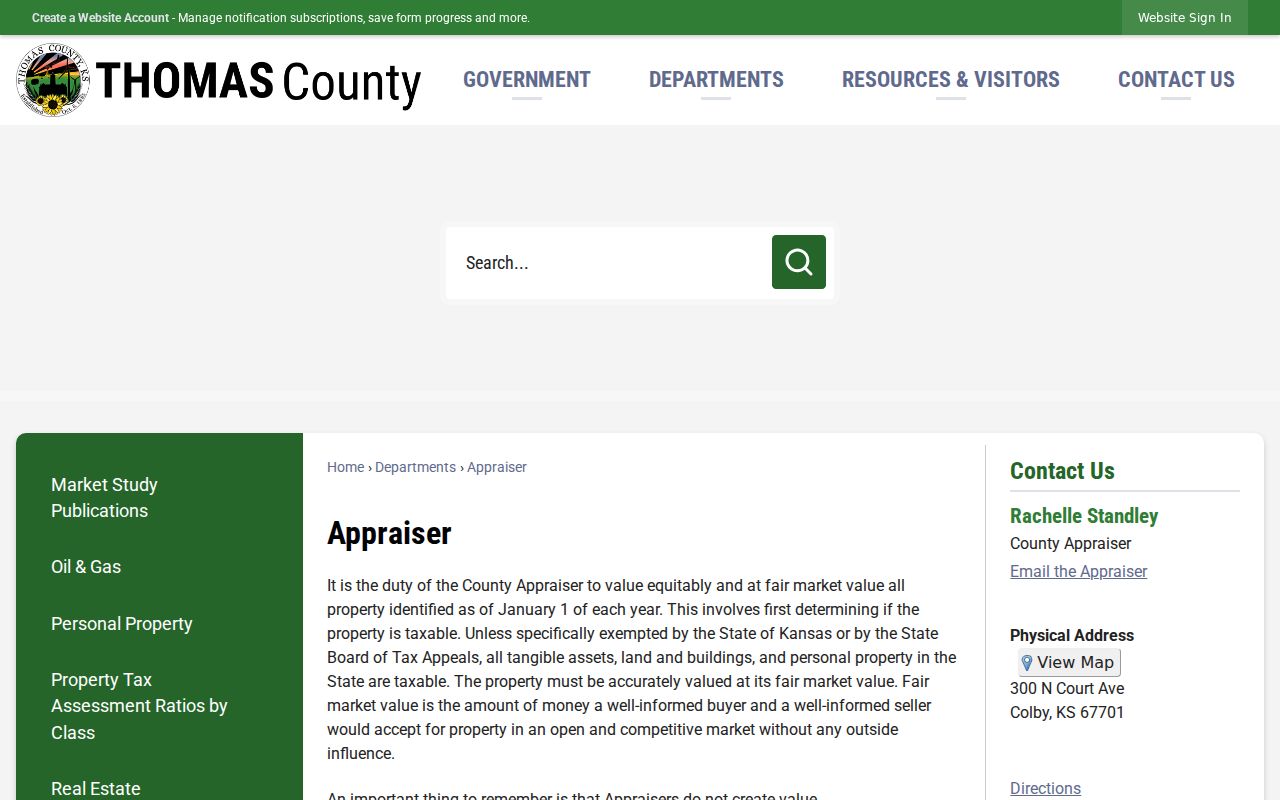
Value resources from that office support assessment review, while payment status stays with the Treasurer. Note: A tax statement may name a taxpayer, but it is not a deed or title certificate.
Thomas County Value Terms
The Appraiser sets fair-market value each January 1. Assessed value is the slice of that figure the Kansas class rate leaves taxable. Mill levies from every taxing unit then drive the final bill. Each term answers a different question, so treat them separately. A parcel's class matters too. Farm ground is valued by use rather than market. Commercial buildings on farm land can fall under another class. A vacant town lot is not a residence. Check the account classification before estimating tax. Never read a sale price out of appraised value, assessed value, or a market-study trend.
Current and Delinquent Thomas Taxes
The portal splits properties with current taxes from statements showing taxes due, delinquent items included. Search several years to trace payment history. Keep the tax type steady, too. That way a mineral interest is never mistaken for real estate in Thomas County property records.
Once unpaid real estate reaches publication or a county purchase, ask the Treasurer directly. Get the year, the amount, the redemption posture, and the next step in writing. Publication itself is not a completed conveyance. Any deed, lien, or release still needs a separate Register of Deeds search.
A written request works best when it lists the tax ID, CAMA number, owner or taxpayer spelling, address, tax type, and the years in question. Request the statement, the payment status, and the public delinquency record as three distinct items. Each comes from a different part of the county's tax records.
Read the 2025 Thomas Study
The county's 2025 study reported a 2 percent residential trend, no commercial trend, and an 8 percent vacant-lot trend. Read that carefully. It does not mean every home rose 2 percent or every vacant parcel rose 8 percent. Treat the study as context for the Thomas County tax roll, then compare parcel class, land and improvement facts, condition, and comparable evidence before drawing conclusions about a specific property. If the dispute is really the bill rather than the value, take it to the Treasurer or the Clerk instead. A payment posting or levy question is a different matter from an appraisal challenge.
Search Thomas Tax Names Carefully
County help suggests entering only the owner's last name at first. Punctuation must match, and failed names often need shortening. Then test Current Owner, Taxpayer, and Both. Estate, trust, and business names may differ from the person tied to the parcel. Save the exact returned form rather than normalizing it. Owner-name results can span real estate, minerals, and other tax types. So match the CAMA number, tax unit, parcel number, address, and legal-description fields before treating two statements as one property. A taxpayer mailing name is a billing clue. It is not final title proof for a Thomas County parcel.
Confirm Thomas Tax Records Offline
Online results sometimes fail. They may also omit the year you need. For value and classification data, call the Appraiser. For statements and payments, call the Treasurer. Provide a narrow set of identifiers and ask whether an electronic copy is available; KORA permits reasonable actual search and copy costs. Title questions belong at the Register of Deeds, with the same legal description in hand. Boundary questions call for the recorded plat and a surveyor, and keeping those channels distinct stops a Thomas County tax record from being asked to prove facts it does not contain.
Audit a Thomas County Statement
Start with the tax year and type. The direct module can search Real Estate, Personal Property, Oil, Gas, Trucks, Minerals, and State Assessed Utilities. It also accepts a year range, CAMA number, tax identification, owner or taxpayer ID, address, subdivision, legal-description fields, lease name, and Quick Ref. A wrong-class result looks related. It is actually answering a different question.
Next, compare the account keys. The tax ID pairs a three-digit tax unit with a ten-digit parcel number. CAMA numbers use eight segmented components instead. County help does not publish what each CAMA segment means geographically, so keep the whole code intact. City lots need subdivision, block, and lot preserved. Rural land needs section, township, and range preserved. These keys let the Treasurer and the Appraiser pull the same account even after a name change. That matters more than any spelling.
Then place the account in the annual cycle. January 1 fixes the appraisal date, and March value notices open the main review period. Certification runs through the summer. The roll is certified and statements mail in November, with current full or first-half payment due December 20. A portal timestamp proves little by itself. It does not mean every appraisal, deed, payment, or exemption changed that day. For delinquent land, record the unpaid year and ask whether the parcel has reached publication, county purchase, redemption, or a later sale procedure. August publication and September county purchase are milestones, not interchangeable outcomes. A tax flag never proves title changed. Confirm any deed or lien with the Register of Deeds and any court proceeding with the District Court Clerk.
Keep proof of the inquiry. Save the search criteria, tax year, date checked, statement status, account identifiers, and the office response. Request a certified or official copy only when the purpose requires it, and confirm the cost first. The Kansas Open Records Act allows a focused written request without a prescribed form, while permitting actual reasonable search and copy charges. A precise request routes faster and verifies more easily. On value, separate market context from the parcel's own evidence, because the countywide 2025 study's residential and vacant-lot trends do not dictate any single assessment. Weigh property class, use, size, improvement facts, condition, and comparable parcels. Agricultural use value demands special care, since it is not simply an estimated open-market sale figure, and a factual correction and a valuation dispute may lead to different conversations with the Appraiser.