
Identify a Thomas County Property Owner
Finding the owner of record begins with the place. A broad search for a person invites mismatches. Thomas County's online CAMA and tax form turns a street address into a parcel account and an owner or taxpayer name. The tax roll is strong evidence. It is not the last word on title. The latest deed filed with the Thomas County Register of Deeds confirms who received the interest and how the land was described. Keep every identifier in one place: CAMA number, tax ID, full legal description, and the owner's exact spelling. That discipline pays off. It keeps a promising result attached to the right tract rather than a near-miss parcel with a similar address.
- Open the Thomas County CAMA and tax search. Enter the street number and street name, adding direction or ZIP only if needed.
- Open the matching result and save its owner or taxpayer name, CAMA number, tax ID, situs address, and complete lot, block, subdivision, or section-township-range description.
- Ask the Thomas County Register of Deeds for the most recent deed under that name and legal description. Compare the grantee and land description.
- If the grantee is a company, check the Kansas Secretary of State Business Search by business name or state ID. Treat its resident-agent entry as an entity contact, not proof that the agent owns the land.
This route names the owner of record without assuming the taxpayer, the occupant, and the mail recipient are the same party. A recent sale can reach the deed books first. The administrative tax record lags behind. Thomas County publishes no fixed transfer-to-roll update interval. When the two sources disagree, record both dates and ask the offices which document is newest.
Thomas County Name Search Shortcut
The county's tax-search help page offers a useful local shortcut. Start with only a last name. Name matching is punctuation-sensitive. A brief surname can surface a record that a full name with initials, commas, or entity suffixes would miss. The form also has an owner-versus-taxpayer choice. That distinction matters when an estate representative, business, or other taxpayer receives the bill while title is vested differently.
A name-first query can show several Thomas County parcels. Treat the list with care. Never assume every row is the same person. Compare the CAMA number, situs, mailing field, tax unit, and legal description one parcel at a time. For a trust or estate, search both the formal record name and a shortened root. For companies, keep the county's exact punctuation. Carry that exact spelling into the state business record before deciding the name is settled.
Note: The September 2026 CAMA update describes database freshness, not the recording date of every deed or transfer.
Addresses Are Different Thomas County Keys
A Thomas County owner lookup can show three different address concepts. The situs address locates the land. The mailing address receives tax notices. It may point to a post office box, a farm office, an entity, or a personal representative. The legal description fixes the land itself. Kansas law also sends a grantee's last known post-office address to the Clerk for tax-mailing purposes. The mail recipient is never proof of title.
- Owner of record
- The party named by the controlling public ownership record.
- Grantee
- The person or entity receiving an interest in a recorded conveyance.
- Vesting
- The wording that states how title is held by one or more parties.
- Situs address
- The property's physical location, distinct from its tax mailing address.
- Legal description
- The lot, block, subdivision, section, township, range, or other land description used in title records.
Colby, Brewster, Rexford, and the county's rural stretches make these distinctions practical. A postal city does not prove municipal limits. An older town lot can carry a changed street address, while a farm is often found most reliably by section, township, and range. Save each identifier first.
Sources Behind Thomas County Ownership
No single public screen answers every part of who owns a property in Thomas County. The tax module is the fastest parcel-to-name connection. The Register of Deeds supplies the recorded conveyance. State entity records explain the legal business appearing as grantee, while maps and plats help tie the name to the intended tract. Keep their roles separate.
| Source | Owner Info It Gives | Access |
|---|---|---|
| CAMA and tax module | Owner or taxpayer name tied to parcel search keys | Online search |
| Register of Deeds | Grantee and vesting in the latest recorded deed | Office visit or request |
| Kansas business search | Business status and resident-agent information | Online search |
| County maps and recorded plats | Geographic context for the parcel and legal description | Online maps plus office records |
Thomas County hosts no public parcel viewer. It offers no remote public deed index either. Statewide ORKA layers still help with roads, address points, subdivisions, lots and blocks, and city limits. The county provides no Thomas-specific click-through owner card, so the dependable route pairs the online tax search with a deed request to the Register of Deeds. A map label orients the work.
Confirm Thomas County Deed Vesting
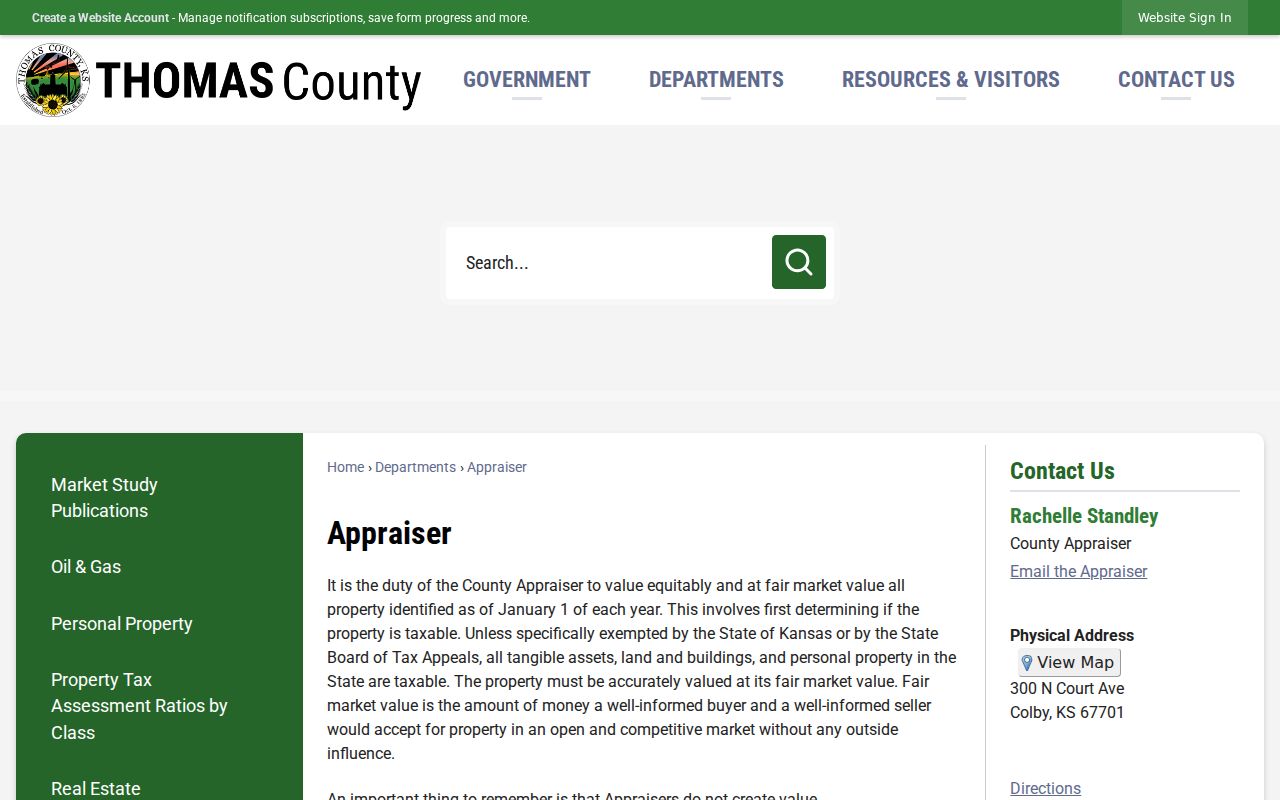
The Register of Deeds keeps deeds, mortgages, releases, easements, plats, liens, and related instruments at the courthouse. The office's own history runs deep. Local land books start in 1885, in-house microfilm in 1972, database entry in 2004, and electronic recording in 2014. Those records are not online, the county says. Electronic submission is not public remote access. The county's official Appraiser page shows the local office context behind the first owner lead from the tax roll.
The Register of Deeds can settle what the CAMA entry and tax roll only suggest. A narrow request gets better results than a broad one. Ask staff for the newest deed on the exact legal description tied to the parcel number. Also request the prior deed if the chain looks incomplete. Include the owner spellings and the rough transfer year. Add any instrument type and a book/page or document number. Copy formats, fees, and certification can wait until a certified copy is genuinely required.
One caution deserves attention. The office's own filing instructions are clear on one point. Take the legal description from the previous deed rather than the Appraiser website. That warning is unusual enough to matter. Compare the deed description against the tax record instead of copying either one blindly.
Recorded proof matters. A tax result is a strong current lead, but the latest applicable deed is the key ownership confirmation.
Thomas County Estates and Trustees
Sometimes the owner of record is not a person's everyday name. A deed can vest land in a trust, an estate, or a company. Probate may authorize a transfer that looks nothing like a routine sale. Search the exact grantee first. Then hunt for related deeds in the deed records. Look for executor's deeds, administrator's deeds, transfer-on-death instruments, affidavits, and court orders.
For an estate transfer, Thomas County District Court records may hold a case number or order. That order explains who had authority to convey. The Kansas district-court access instructions describe online access plus a courthouse-terminal fallback. Sealed and excluded documents stay unavailable. A death certificate is no public shortcut, either. Kansas vital certificates go only to eligible people, representatives, or those proving a direct interest. That interest must be in personal or property rights.
Thomas County Fraud Alert Habit
Once the owner of record is confirmed, the county-linked Property Fraud Alert service builds a monitoring habit. It is not title insurance. It will not stop a filing. An alert simply prompts you to inspect a recording. It also tells you to contact the Register of Deeds when a document is unfamiliar.
Use the county's official link. Deed-copy mailers and fake title-lock notices often mimic government forms. Never trust payment details or phone numbers from an unsolicited demand. Check them against the county office. Keep the envelope, the message, the claimed document reference, and the date if a report becomes necessary. Ownership research works best when it confirms the public trail. It also guards the trail against false claims.
Limits on Thomas County Owner Results
Knowing who owns a Thomas County property has limits. It does not identify everyone living there. It does not prove every lien was released, settle a boundary, or replace a title examination. Tax mailing information can point away from the situs. Safe at Home lets qualifying victims place a substitute address in official records. Sales Validation Questionnaires carry access limits of their own. Military discharges do too. Court or vital records may be sealed or restricted.
Kansas Open Records Act access is not permission to build a personal dossier. K.S.A. 45-230 restricts certain commercial uses of public lists of names and addresses. Property records serve the issue at hand. That might be purchase diligence, an easement question, estate work, a suspected filing, or civic review. Sensitive details that never answer the property question should not be copied or republished.
Lawful use. Thomas County owner records support lawful property research. Kansas law forbids stalking, and no address or owner data may be used to harass, threaten, or harm anyone.
Competing deeds, probate interests, mineral rights, easements, or boundary claims can complicate the answer. A professional title search or legal advice may be needed. Public lookup results supply leads and documents, but they do not adjudicate those claims.